
Effect of Papaya ringspot virus watermelon strain on growth, yield and quality of melon
Article Sidebar
Main Article Content
Abstract
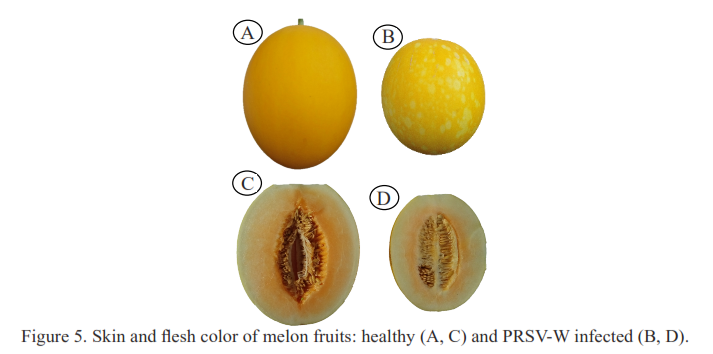
Papaya ringspot virus watermelon strain (PRSV-W) is a member of the genus Potyvirus that infects Cucurbitaceae crops. The first occurrence of PRSV-W in Indonesia was reported in Bali in 2022. However, information regarding yield loss caused by PRSV-W infection in melon has not yet been reported. This study aimed to analyze yield loss and changes in fruit quality of melon resulting from PRSV-W infection. The research methods included individual and population level disease observations, assessment of agronomic variables and disease severity, yield loss estimation, and data analysis. Observations were conducted at the Pegok Experimental Farm, Faculty of Agriculture, Udayana University, covering an area of 1000 m². The observed plant ages ranged from 6 to 66 days after planting (dap). Mosaic disease development was observed from 18 dap until before harvest. The highest disease incidence and disease severity recorded at the end of the observation period were 58.4% and 61.8%, respectively. Actual yield loss, calculated by comparing mosaic symptomatic and asymptomatic melon plants, reached 49.45%. The most prominent quality defects were changes in fruit color and shape and fruit malformation, with values of 14.06% and 17.5%, respectively. The greatest economic loss occurred in plots with an AUDPC value of 751, resulting in a total yield loss of IDR 15,721,500. Yield loss showed strong correlations with disease incidence and disease severity, with correlation values of 95.41% and 96.19%, respectively. PRSV-W infection altered fruit skin color from yellow-orange to pale yellow with ringspot symptoms, and PRSV-W was detected in the skin tissues of infected fruits. In addition, PRSV-W infection reduced fruit sweetness to 9–12 °Brix, whereas healthy fruits exhibited sweetness levels of 14–17 °Brix.
Article Details

This work is licensed under a Creative Commons Attribution-NonCommercial 4.0 International License.
Authors retain copyright of their published articles and grant the journal the right of first publication.
All articles published in Jurnal Hama dan Penyakit Tumbuhan Tropika: Journal of Tropical Plant Pests and Diseases are licensed under the Creative Commons Attribution-NonCommercial 4.0 International (CC BY-NC 4.0) license.
This license permits others to share, copy, distribute, and adapt the published work for non-commercial purposes, provided that appropriate credit is given to the original author(s) and the journal.
References
Ahsan M, Ashfaq M, Amer MA, Shakeel MT, Mehmood MA, Umar M, & Al-Saleh MA. 2023. Zucchini yellow mosaic virus (ZYMV) as a serious biotic stress to cucurbits: Prevalence, diversity, and its implications for crop sustainability. Plants. 12(19): 3503. https://doi.org/10.3390/plants12193503
Damayanti TA, Nurjannah T, Listihani L, Hidayat SH, & Wiyono S. 2022. Characterization of a variant isolate of Zucchini yellow mosaic virus infecting green kabocha (Cucurbita maxima L.) in Bogor, Indonesia. Arch. Phytopathol. Plant Prot. 55(1): 121–128. https://doi.org/10.1080/03235408.2021.2003604
Damicone JP, Edelson JV, Sherwood JL, Myers LD, & Motes JE. 2007. Effects of border crops and intercrops on control of cucurbit virus diseases. Plant Dis. 91(5): 509–516. https://doi.org/10.1094/pdis-91-5-0509
Daryono BS & Natsuaki KT. 2009. Survey on the occurrence of viruses infecting cucurbits in Yogyakarta and Central Java. JPTI. 15(2): 83–89. https://doi.org/10.22146/jpti.11769
Harmiyati T, Hidayat SH, & Adnan AM. 2015. Deteksi dan respons lima varietas pepaya terhadap tiga isolat Papaya ringspot virus (PRSV) [Detection and response of five varieties of papaya to three isolates of Papaya ringspot virus (PRSV)]. J. AgroBiogen. 11(3): 87–94.
Hidayat SH, Nurlita S, & Wiyono S. 2012. Infeksi Papaya ringspot virus pada tanaman pepaya di Provinsi Nanggroe Aceh Darussalam [Infection of Papaya ringspot virus on papaya in Nanggroe Aceh Darussalam Aceh Province]. J. Fitopatol. Indones. 8(6): 184–187. https://doi.org/10.14692/jfi.8.6.184
Hutasoit RT, Jihad M, Listihani L, & Selangga DGW. 2023. The relationship between vector insect populations, natural enemies, and disease incidence of tungro virus during wet and dry seasons. Biodiversitas. 24(7): 4001–4007. https://doi.org/10.13057/biodiv/d240737
Kirchner JE, Ritchie MJ, Pitcock JA, Parker LE, Curran GM, & Fortney JC. 2014. Outcomes of a partnered facilitation strategy to implement primary care-mental health. J. Gen. Intern. Med. 29(Suppl 4): 904–912. https://doi.org/10.1007/s11606-014-3027-2
Li N, Yu C, Yin Y, Gao S, Wang F, Jiao C, & Yao M. 2020. Pepper crop improvement against Cucumber mosaic virus (CMV): A review. Front. Plant Sci. 11: 598798. https://doi.org/10.3389/fpls.2020.598798
Listihani L, Damayanti TA, Hidayat SH, & Wiyono S. 2018. Karakterisasi molekuler Papaya ringspot virus tipe P pada tanaman mentimun di Jawa [Moleculer characterization of Papaya ringspot virus type P on cucumber in Java]. J. Fitopatol. Indones. 14(3): 75. https://doi.org/10.14692/jfi.14.3.75
Listihani. 2019. Karakterisasi dan Epidemi Virus pada Tanaman Mentimun di Pulau Jawa [Characterization and Epidemy of Viruses on Cucumber in Java Island]. Dissertation. IPB University. Bogor.
Listihani L, Damayanti TA, Hidayat SH, & Wiyono S. 2020. First report of cucurbit aphid-borne yellows virus on cucumber in Java, Indonesia. J. Gen. Plant Pathol. 86(3): 219–223. https://doi.org/10.1007/s10327-019-00905-2
Listihani, Pandawani NP, Damayanti TA, Sutrawati M, Selangga DGW, Yuliadhi KA, Phabiola TA, & Wirya GNAS. 2022. Distribution and molecular characterization of Squash mosaic virus on cucumber in Gianyar, Bali. J. Trop. Plant Pests Dis. 22(1): 48–54. https://doi.org/10.23960/jhptt.12248-54
Listihani, Selangga DGW, & Sutrawati M. 2021. Natural infection of Tobacco mosaic virus on butternut squash in Bali, Indonesia. J. Trop. Plant Pests Dis. 21(2): 116–122. https://doi.org/10.23960/jhptt.221116-122
López-Martín M, Montero-Pau J, Ylla G, Gómez-Guillamón ML, Picó B, & Pérez-de-Castro A. 2024. Insights into the early transcriptomic response against watermelon mosaic virus in melon. BMC Plant Biol. 24(1): 58. https://doi.org/10.1186/s12870-024-04745-x
Luis-Arteaga M, Alvarez JM, Alonso-Prados JL, Bernal JJ, García-Arenal F, Laviña A, Batlle A, & Moriones E. 1998. Occurrence, distribution, and relative incidence of mosaic viruses infecting field-grown melon in Spain. Plant Dis. 82(9): 979–982. https://doi.org/10.1094/PDIS.1998.82.9.979
Maachi A, Donaire L, Hernando Y, & Aranda MA. 2022. Genetic differentiation and migration fluxes of viruses from melon crops and crop edge weeds. J. Virol. 96(16): e00421-22. https://doi.org/10.1128/jvi.00421-22
Maina S, Barbetti MJ, Edwards O, de Almeida L, Ximenes A, & Jones RAC. 2018. Sweet potato feathery mottle virus and Sweet potato virus C from East Timorese and Australian sweetpotato: Biological and molecular properties, and biosecurity implications. Plant Dis. 102(3): 589–599. https://doi.org/10.1094/PDIS-08-17-1156-RE
Maina S, Coutts BA, Edwards OR, de Almeida L, Kehoe MA, Ximenes A, & Jones RAC. 2017a. Zucchini yellow mosaic virus populations from East Timorese and Northern Australian cucurbit crops: Molecular properties, genetic connectivity and biosecurity implications. Plant Dis. 101(7): 1236–1245. https://doi.org/10.1094/PDIS-11-16-1672-RE
Maina S, Coutts BA, Edwards OR, de Almeida L, Ximenes A, & Jones RAC. 2017b. Papaya ringspot virus populations from East Timorese and Northern Australian cucurbit crops: Biological and molecular properties, and absence of genetic connectivity. Plant Dis. 101(6): 985–993. https://doi.org/10.1094/PDIS-10-16-1499-RE
Moya-Ruiz CD, Gómez P, & Juárez M. 2023. Occurrence, distribution, and management of aphid-transmitted viruses in cucurbits in Spain. Pathogens. 12(3): 422. https://doi.org/10.3390/pathogens12030422
Pandawani NP, Listihani L, Widnyana IK, Ariati PEP, & Selangga DGW. 2022. High impact of Clerodendrum paniculatum leaf extract to suppress Zucchini yellow mosaic virus infection in zucchini plants. Biodiversitas. 23(6): 2914–2919. https://doi.org/10.13057/biodiv/d230618
Philosoph AM, Dombrovsky A, Elad Y, Jaiswal AK, Koren A, Lachman O, & Frenke O. 2018. Combined infection with Cucumber green mottle mosaic virus and Pythium species causes extensive collapse in cucumber plants. Plant Dis. 102(4): 753–759. https://doi.org/10.1094/PDIS-07-17-1124-RE
Premchand U, Mesta RK, Basavarajappa MP, Venkataravanappa V, Reddy LRCN, & Shankarappa KS. 2025. Epidemiological studies on the incidence of papaya ringspot disease under Indian sub-continent conditions. Sci. Rep. 15: 6973. https://doi.org/10.1038/s41598-025-91612-w
Ramirez II S, Schmer MR, Jin VL, Mitchell RB, Stewart CE, Parsons J, Redfearn DD, Quinn JJ, Varvel GE, Vogel KP, & Follett RF. 2024. Perennializing marginal croplands: Going back to the future to mitigate climate change with resilient biobased feedstocks. Front. Energy Res. 11: 1272877. https://doi.org/10.3389/fenrg.2023.1272877
Regulations of the Minister of Agriculture. 2020. Minister of Agriculture Regulation Number 25 of 2020 concerning Types of Quarantine Plant Pest Organisms. Ministry of Agriculture. Indonesia. https://peraturan.bpk.go.id/Details/201266/permentan-no-25-tahun-2020. Accesed January 15 2025.
Rezende JAM & Pacheco DA. 1998. Control of Papaya ringspot virus-type W in zucchini squash by cross-protection in Brazil. Plant Dis. 82(2): 171–175. https://doi.org/10.1094/PDIS.1998.82.2.171
Roques L, Desbiez C, Berthier K, Soubeyrand S, Walker E, Klein EK, Garnier J, Moury B, & Papaïx J. 2021. Emerging strains of Watermelon mosaic virus in Southeastern France: model-based estimation of the dates and places of introduction. Sci. Rep. 11: 7058. https://doi.org/10.1038/s41598-021-86314-y
Selangga DGW, Widnyana IK, & Listihani L. 2021. The existence of Papaya ringspot virus-papaya strain on cucumber in Gianyar, Bali. JPTI. 25(1): 48–55. https://doi.org/10.22146/jpti.64703
Selangga DGW & Listihani L. 2022. Squash leaf curl virus: Species of Begomovirus as the cause of butternut squash yield losses in Indonesia. Hayati J. Biosci. 29(6): 806–813. https://doi.org/10.4308/hjb.29.6.806-813
Selangga DGW, Temaja IGRM, Wirya GNAS, Sudiarta IP, & Listihani L. 2022. First report of Papaya ringspot virus-watermelon strain on melon (Cucumis melo L.) in Bali, Indonesia. Indian Phytopathol. 75: 911–914. https://doi.org/10.1007/s42360-022-00534-4
Selangga DGW, Listihani L, Temaja IGRM, Wirya GNAS, Sudiarta IP, & Yuliadhi KA. 2023. Determinants of symptom variation of Pepper yellow leaf curl Indonesia virus in bell pepper and its spread by Bemisia tabaci. Biodiversitas. 24(2): 869–877. https://doi.org/10.13057/biodiv/d240224
Shehata WF, Iqbal Z, Abdelbaset TE, Saker KI, El Shorbagy AE, Soliman AM, Sattar MN, & El-Ganainy SM. 2023. Identification of a Cucumber mosaic virus from Cucurbita pepo on new reclamation land in Egypt and the changes induced in pumpkin plants. Sustainability. 15(12): 9751. https://doi.org/10.3390/su15129751
Singh BK, Delgado-Baquerizo M, Egidi E, Guirado E, Leach JE, Liu H, & Trivedi P. 2023. Climate change impacts on plant pathogens, food security and paths forward. Nat. Rev. Microbiol. 21(10): 640–656. https://doi.org/10.1038/s41579-023-00900-7
Tian S, Diao Q, Cao Y, Yao D, Zhang W, Zhang H, Du X, & Zhang Y. 2024. Overview of research on virus-resistant breeding of melon. Front. Plant Sci. 15: 1500246. https://doi.org/10.3389/fpls.2024.1500246
Tripathi S, Suzuki JY, Ferreira SA, & Gonsalves D. 2008. Papaya ringspot virus-P: Characteristics, pathogenicity, sequence variability and control. Mol. Plant Pathol. 9(3): 269–280. https://doi.org/10.1111/j.1364-3703.2008.00467.x
Wakmana W, Kontong MS, Teakle DS, & Persley DM. 2002. Watermelon mosaic virus of pumpkin (Cucurbita maxima) from Sulawesi: Identification, transmission, and host range. Indones. J. Agric. Sci. 3(1): 33–36. https://doi.org/10.21082/ijas.v3n1.2002.p33-36
Wang D, Li G, & Du SS. 2017. Occurrence of viruses infecting melon in Xinjiang of China and molecular characterization of Watermelon mosaic virus isolates. Eur. J. Plant Pathol. 147(4): 919–931. https://doi.org/10.1007/s10658-016-1060-1
Xie Y & Wu J. 2022. Detection of Cucumber green mottle mosaic virus (CGMMV) in Cucurbitaceous crop seeds by RT-PCR. Methods Mol. Biol. 2400: 275–282. https://doi.org/10.1007/978-1-0716-1835-6_26